Short answer: FLYZOR supports the people who sell and fly our drones. Dealers and service teams get pilot and repair training with the first units. Every first order comes with a recommended spare-parts kit, and our team answers technical questions by email and messaging. The warranty is 12 months on the drone and 3 months on accessories.
Training
Good training is the most important part of a drone business. We train the people who will fly and repair the drones:
| Training | Who it is for | What it covers |
|---|---|---|
| Pilot training | Dealers, service teams, farm operators | App and route planning, calibration, spraying and spreading settings, safe take-off and landing, emergency procedures |
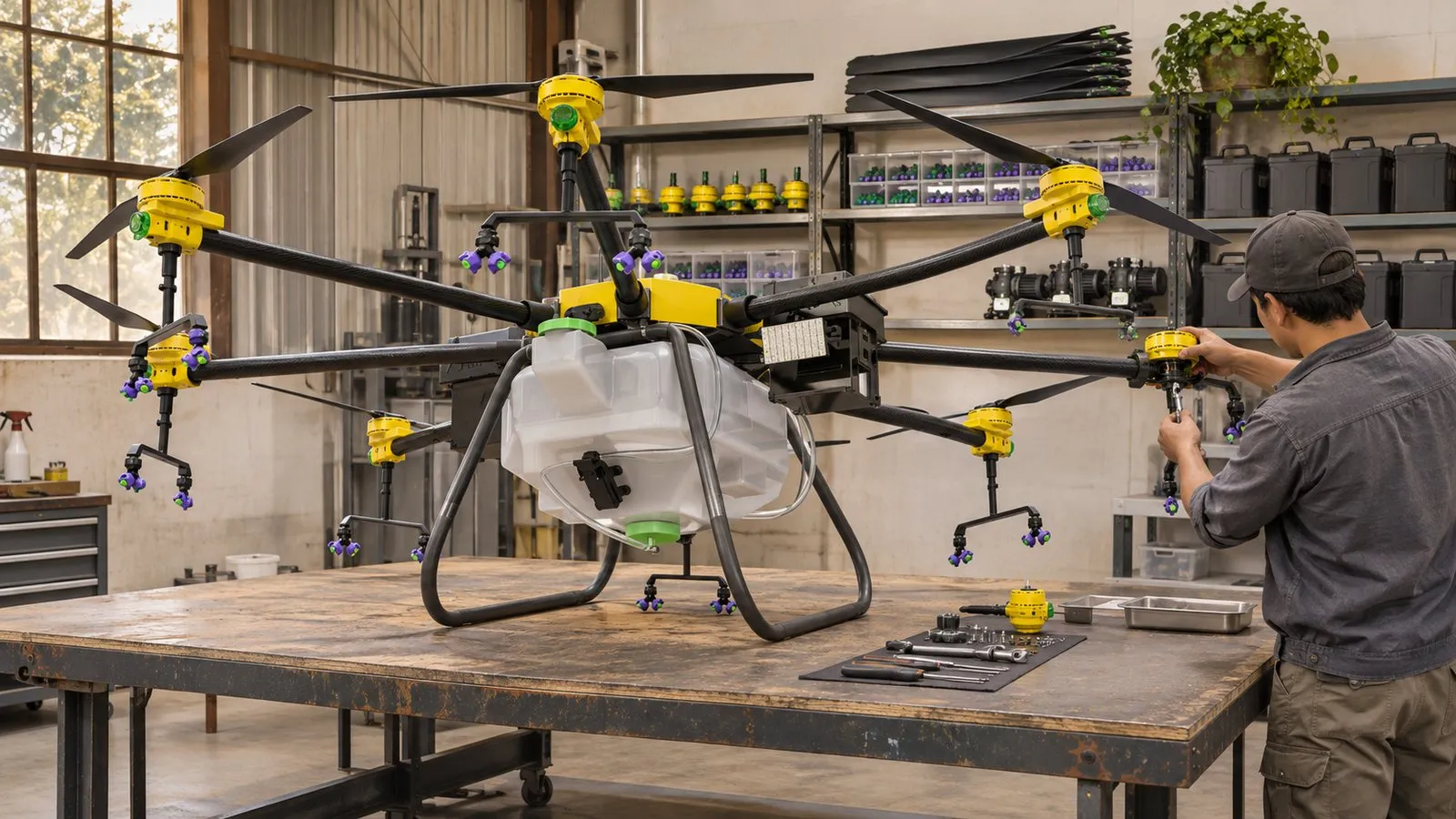
| Repair training | Dealer technicians | Replacing arms, motors, propellers, pumps and nozzles; reading error messages; battery handling |
| Business coaching | Dealers and new service companies | Sizing battery sets and crews, pricing per hectare, demonstrations for farmers |
Ask us how training is arranged for your country when you order. Local pilot certification, where required, remains the operator’s responsibility.
Warranty
- Drone: 12 months from delivery.
- Accessories: 3 months from delivery.
- Not covered: crash and impact damage, wear parts used up in normal work, damage from wrong charging, storage or unauthorised modification.
To claim, send the model, serial number, a short description and photos or a video of the fault. We confirm the next step, usually a replacement part.
Spare parts
If a drone waits two weeks for a spare propeller, the customer loses valuable spraying days. We quote a spare-parts kit with every first order, sized to the number of drones:
- propellers and propeller clamps;
- nozzles, filters and a spare pump;
- arm joints and landing-gear parts;
- motor and ESC for the most exposed arm positions;
- charging cables and fuses.
Dealers keep this stock locally and reorder as it is used.
Technical help
Write to us with the model, serial number, what happened and a photo or short video. Most questions, such as calibration, app settings or a pump that does not prime, are solved remotely.
Documents
Each drone comes with a user manual, a quick-start guide and maintenance notes. CE documents are supplied with the order for customs clearance. Dealers also receive product photos and specification sheets for their own marketing and tenders.
Daily and weekly maintenance
Most breakdowns are prevented by a few minutes of care. A routine we recommend:
| When | What to check |
|---|---|
| Before each flight | Propellers for cracks, arm locks closed, battery seated, tank cap closed, GPS and radar status in the app |
| After each day | Rinse tank, pump and nozzles with clean water; wipe the body; check nozzles and filters; let batteries cool before charging |
| Every week | Check motor mounts and screws, clean the radar and camera, inspect cables and connectors, update the flight log |
| Before storage | Clean thoroughly, dry, store batteries about half-charged in a cool, dry place |
Bodies rated IP67, such as the F72 and F92, can be rinsed with water. Always remove the batteries first and follow the manual for your model.
Battery care
Batteries are the most expensive consumable in a drone fleet. Do not charge them while still hot from flight, avoid deep discharge, keep them out of direct sun, and transport them in protective cases. Retire swollen or damaged packs straight away.
Contact support
Existing customers write to sales@flyzor.com or use the contact form. Dealers interested in becoming a service point can read about our dealer program.