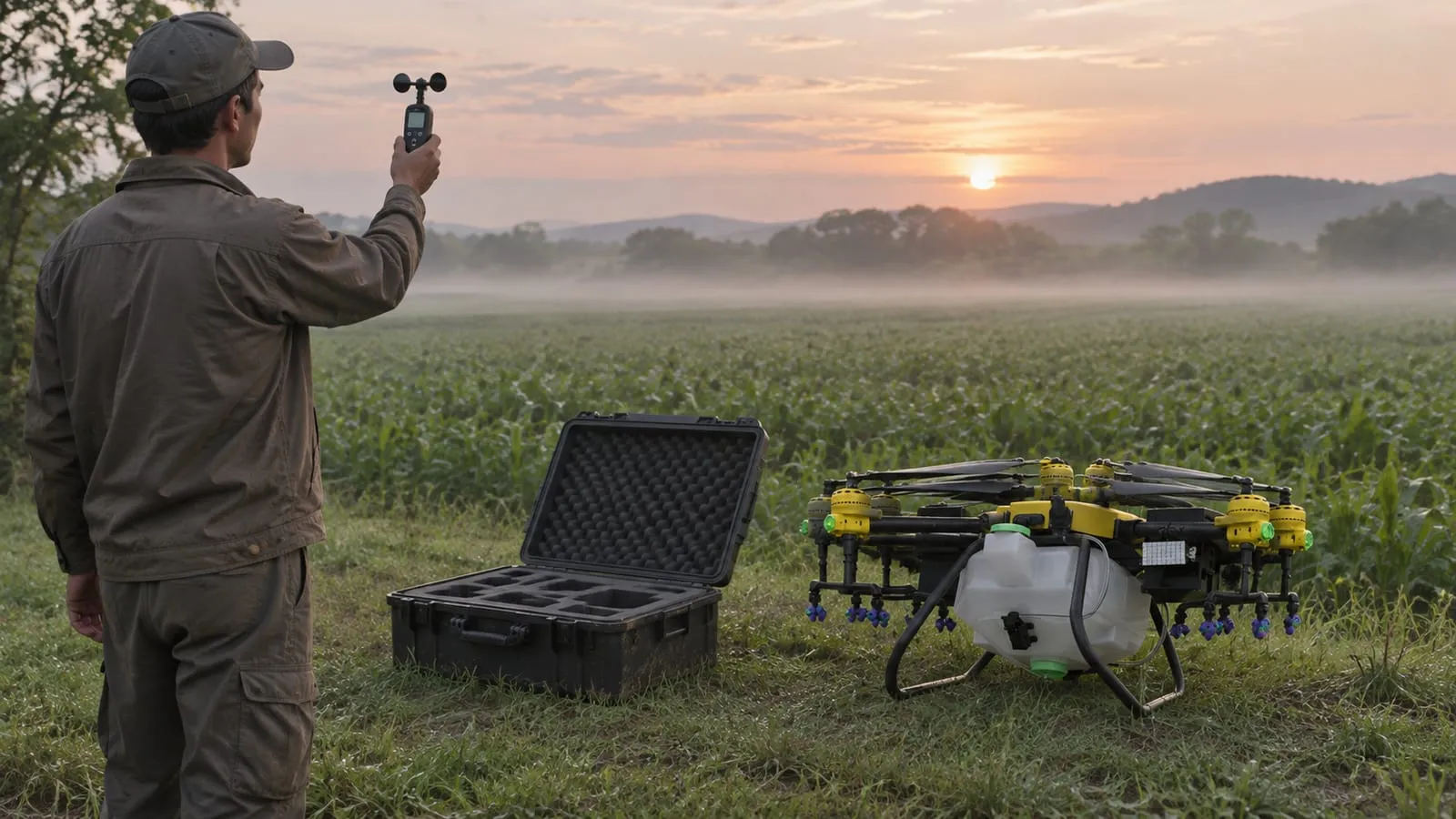
Short answer: Spray when the wind is low and steady, the air is not too hot, and rain is not coming within the label’s rainfast time. As a reference, an Indian research-institute guide for drone spraying in rice stops work above 3 m/s (about 10.8 km/h). Your label and local rules may be stricter. Spray in the cool hours of early morning or late afternoon, and measure wind at crop height with a meter.
Label first
Every pesticide label can set wind, temperature and buffer rules. In many countries the label is law. This guide gives reference values from extension and research sources to help you plan. If a label is stricter, use the label. If your local plant protection office has a rule, use that. Ask them before your first season.
The go, caution and stop table
| Condition | Go | Caution | Stop |
|---|---|---|---|
| Wind speed (reference) | Under 2 m/s, steady | 2 to 3 m/s, gusts or changing direction | Above 3 m/s, or above the label limit |
| Wind direction | Away from homes, water and sensitive crops | Across the field edge toward a sensitive area | Toward people, homes, ponds or sensitive crops |
| Temperature | Cool: early morning or late afternoon | Rising; batteries and tank warm to touch | Hot sun, high heat; forced battery landings above about 35 °C (95 °F) |
| Humidity | Higher humidity slows droplet evaporation | Dropping fast with heat | Very dry, hot air with fine droplets |
| Rain | No rain inside the label's rainfast time | Showers possible | Rain expected soon, or leaves wet and dripping |
| Air near the ground | Mixing, light breeze | Dead calm and clear early morning | Signs of an inversion, such as smoke or mist lying flat |
The Indian rice guide gives an operating window of 2 to 3 m/s and says to stop above 3 m/s. The “under 2 m/s” column is our own planning margin for small droplets, not a figure from a source. They are not a legal limit anywhere unless your label or authority says so.
Why each factor matters
Wind. It moves small droplets sideways. Research from the University of Iowa on drone droplets of 112 to 179 µm also says that a safe upper wind limit still needs more study. Drone droplets are small, so keep a margin.
Heat and humidity. The Indian guide says high temperature and low humidity speed up evaporation, which cuts efficacy and raises drift. Cool, humid hours also give the leaf more time to absorb the product.
Battery heat. Purdue warns that on very sunny days above 35 °C (95 °F) batteries can overheat and cause a forced landing. Shade the charging area. See the battery guide.
Inversions. Purdue lists local wind and the chance of inversions among the first things to check at a site. Ask your local extension service for the signs in your climate.
Rain. The label gives the rainfast period. Follow it.
A daily routine
- Before leaving, check the forecast for wind, rain and heat.
- At the field, measure wind at crop height. Write the time, speed and direction.
- Check again every 30 minutes and whenever the flags, leaves or trees move more.
- Stop at the stop limit. Do not “finish this one pass”.
- Record what you did for every field.
Planning your spray window
Example: In a rice area, the forecast shows wind of 2 m/s from 6:00 to 8:30, then 4 m/s from 9:00 to 15:00, then 2 m/s again from 16:30 to 18:30. Your window is about 2.5 h in the morning plus 2 h in the evening, so 4.5 h. An F72 with a 12 m effective swath covers about 13 ha/h by the site formula (12 x 1.08, which already counts 50 % field efficiency). In 4.5 h, that is roughly 58 ha for one drone. If the customer has 150 ha, plan for three days or a second drone, and do not extend the window into stronger wind. See our daily output guide.
For dealers
Include a wind meter in the first order list and ask your customer to log wind. It also protects you when a neighbour complains. Read the drift guide next. To discuss kits and training, use the dealer page; terms are agreed in the quotation.