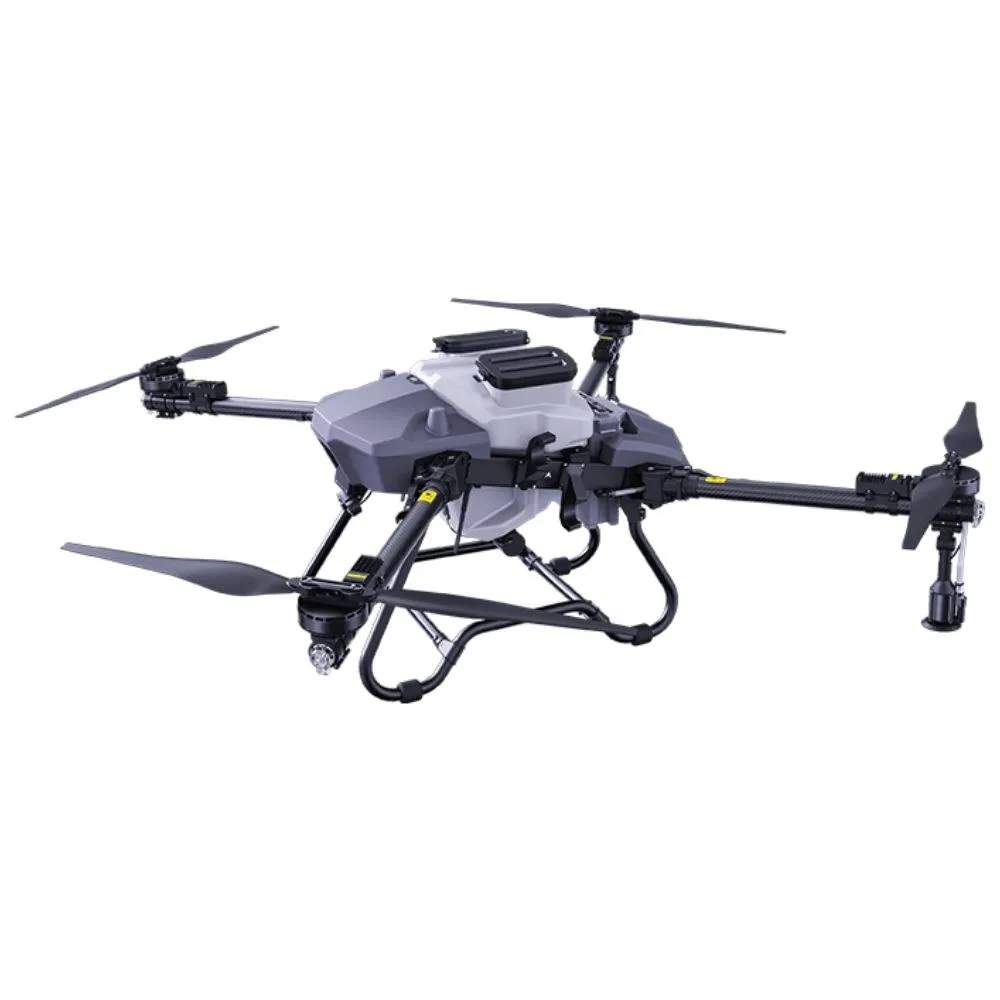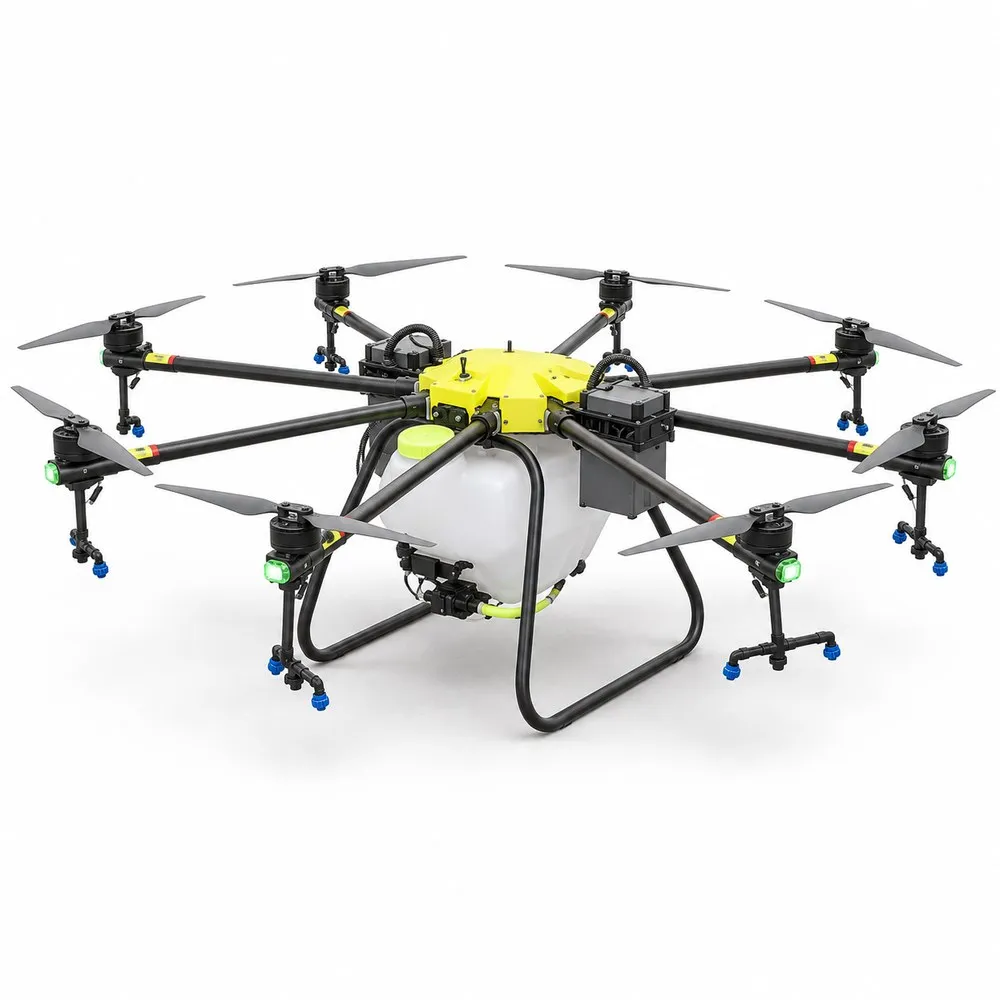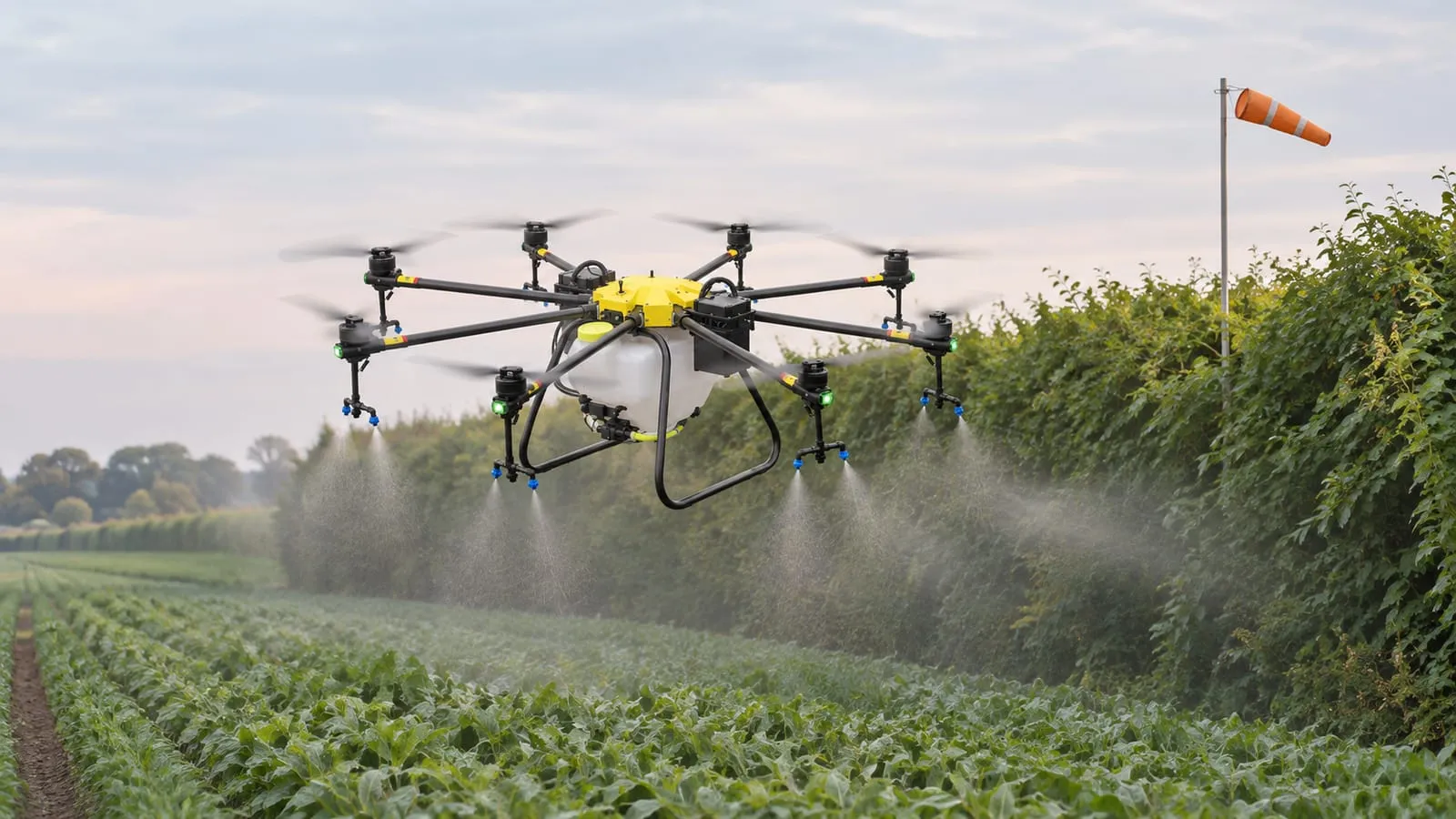
Short answer: Spray drones make smaller droplets than most ground sprayers, so they need careful settings. Research from the University of Iowa measured drone droplets of 112 to 179 µm against 303 to 423 µm for ground sprayers. Droplets under 200 µm carry the most drift risk. You can lower the risk with low flight height, steady speed, a medium droplet size, a wind limit, and buffers next to sensitive areas.
What the research found
The best-known field comparison is Gibbs, Peters and Heck (2021, University of Iowa, published in Transactions of the ASABE). They sprayed corn with drones and with ground rigs. Drone droplets were much smaller. Drone coverage was high in the middle of the swath and the pattern was narrow. The ground rigs showed more downwind drift in that trial, but the authors say this was partly because the drones did not fully reach the field boundary. They also write that more research is needed to find a safe upper wind limit for drone sprays that use small droplets. That is an honest warning: do not read the study as permission to spray in any wind.
Purdue Extension adds two points. A few studies suggest that a drone more than about 3 m (10 ft) above the crop is likely to cause more drift, and drift is expected to increase as speed and height go up. Purdue also notes that nobody yet knows how much of the spray cloud is carried down by the rotor wind and how much is pushed sideways or up.
A peach orchard trial from Beijing tested three flight speeds. Deposition in the canopy was highest at 2 m/s. Near-field ground drift was highest at 1 m/s and airborne drift far downwind was highest at 3 m/s. Faster flight helped droplets spread and enter the canopy but made deposition less even.
Six actions that cut drift
| # | Action | What to do | Source or basis |
|---|---|---|---|
| 1 | Keep the drone low | Fly at the lowest height that gives an even pattern. The Indian rice guide gives 1.5 to 2.0 m above the canopy for drones of about 20 kg payload and slightly higher for heavier ones. | ICAR / IRRI; Purdue |
| 2 | Keep speed steady | Do not fly faster just to finish earlier. Test two or three speeds on your own crop. | Purdue; peach trial |
| 3 | Choose the droplet class | Use medium droplets unless the label says otherwise. Avoid very fine settings. | ICAR / IRRI; Iowa trial |
| 4 | Set a wind limit | Measure wind at crop height with a meter. The rice guide stops work above 3 m/s. Use the stricter of that, your label and local law. | ICAR / IRRI |
| 5 | Leave buffers | Purdue suggests a no-spray strip of half the spray width, or about 3 m (10 ft), along fences with trees and brush. Larger buffers apply near homes, water and sensitive crops, so check local rules. | Purdue |
| 6 | Plan the job and keep records | Map sensitive areas, wind direction and your own position. Record wind, height, speed, nozzle and time for every field. | Purdue |
How droplet size trades off
| Droplet size | Coverage | Drift risk | Note |
|---|---|---|---|
| Under 100 µm | High | High | Also evaporates quickly in heat |
| About 100 to 200 µm | Good | Raised | Common for drones; needs a low wind limit |
| About 250 µm | Good for many herbicides | Moderate | Target in the Indian rice guide |
| Over 300 µm | Fewer droplets per cm² | Low | May leave gaps in coverage |
Example: An operator has a 12 m effective swath. Purdue’s buffer idea of half the swath is 6 m. A strip 6 m wide along a stream is left unsprayed, and a note goes in the job record. Check the legal buffer first, because the label or local law may require more.
What this means for buying
Ask the supplier how droplet size is set and what range it covers. On our product pages, the F30C/F50C lists centrifugal nozzles at 50 to 500 µm, and the F52 lists 30 to 400 µm. Read the nozzle guide, the calibration guide and the weather limits guide together. For terms and training, see the dealer page.