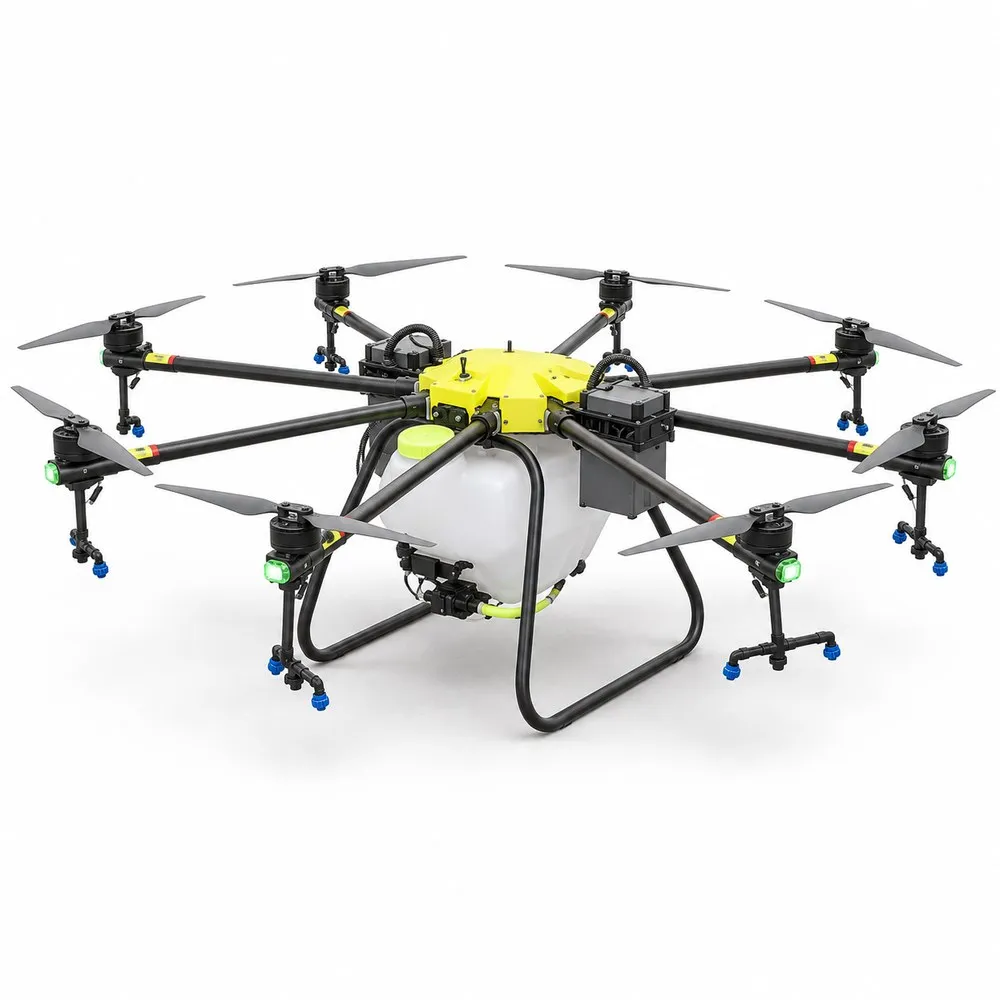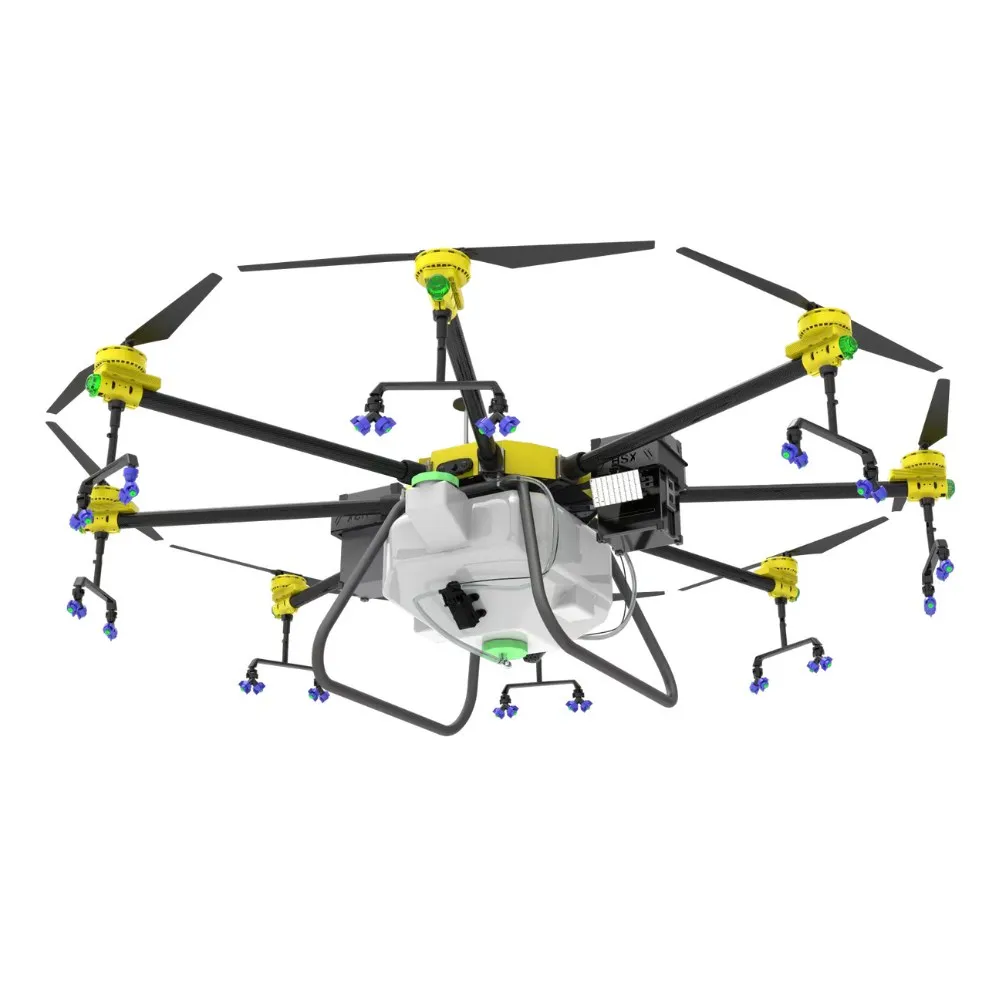
Short answer: To calibrate a spray drone, do three checks in this order. First, check that every nozzle gives the same flow. Second, find the real working width with a swath test. Third, spray a known area and measure how much liquid the tank lost. If the measured rate is more than 5 % away from the rate you want, adjust and test again. Purdue Extension gives this method for spray drones and says a drone is not ready to spray just because it came out of the box.
Why calibration matters for a dealer or service team
A drone that sprays 15 % too little leaves pests alive. One that sprays 15 % too much wastes product, can hurt the crop and raises drift risk. Both cost money. For a spray service, a repeat visit to fix a bad job costs more than the hour it takes to calibrate. For a dealer, teaching the customer to calibrate is part of a good handover.
Step 1: clean and check the nozzles
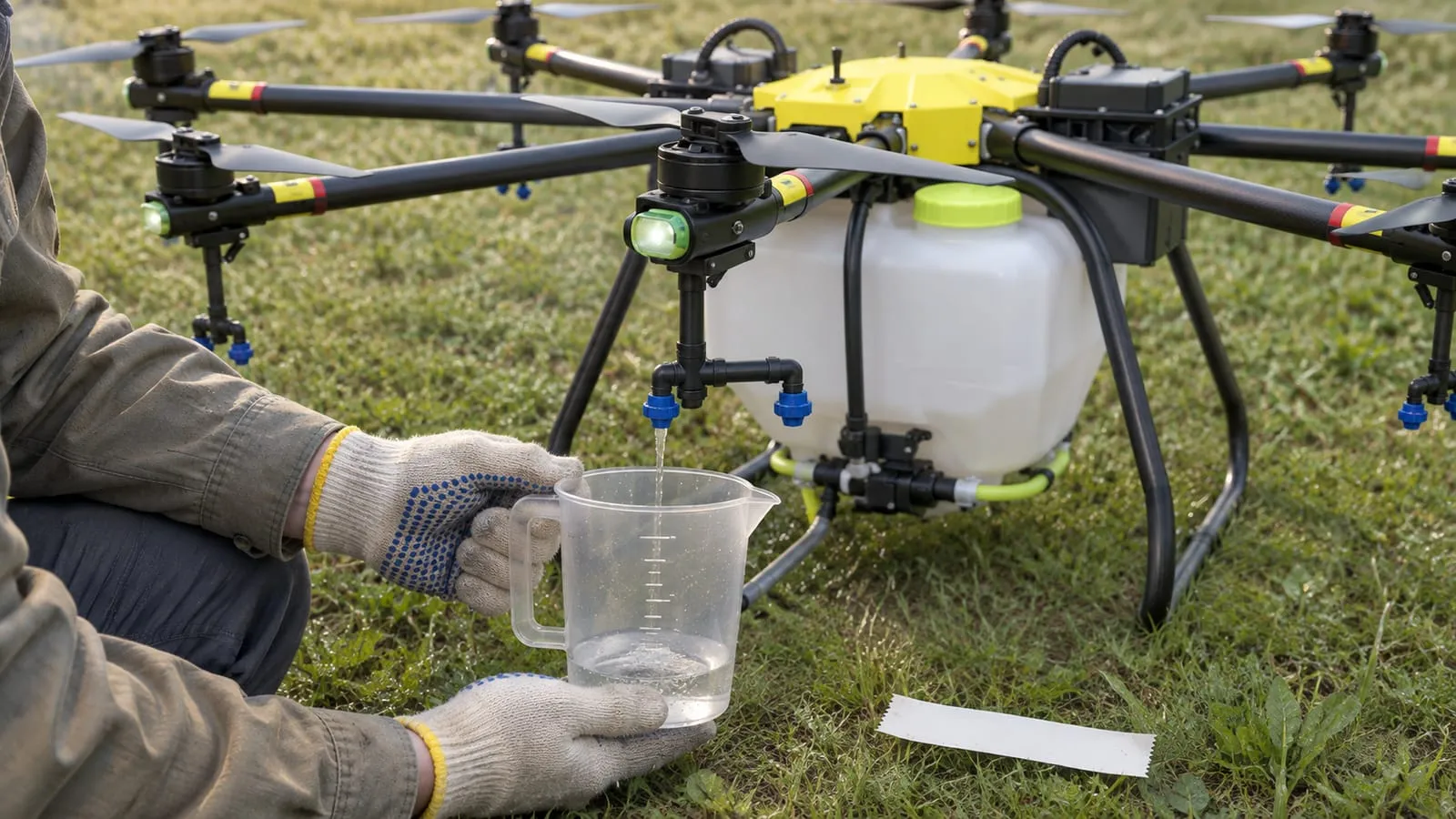
Wear gloves and eye protection. Clean the system and run the pump with clean water on the ground. Check for leaks. Then collect the flow from each nozzle for at least 30 seconds. Purdue says to replace a nozzle if its flow is more than 10 % above the flow of a new nozzle of the same type and size. Large drones often have two pumps and two flow meters. If one side is clearly different from the other, suspect that pump or meter.
Step 2: find the effective swath
Lay paper tape or water-sensitive cards across the flight line. Add food-grade dye to the tank if you use tape. Fly the drone over them at your normal height and speed. Look for heavy dye where passes overlap and bare strips where they do not. Purdue says the effective swath is often 65 to 75 % of the advertised swath and that you must test your own setup, because height, wind and droplet size change it. Do the test again in different wind conditions.
Step 3: the formula
Area covered per minute in hectares is 0.006 x speed (m/s) x swath (m). So:
Litres per hectare = flow (L/min) / (0.006 x speed x swath), which is the same as flow x 166.7 / (speed x swath).
To find the flow you need for a target rate, turn it around: flow (L/min) = rate (L/ha) x 0.006 x speed x swath.
| Input | Example value | Note |
|---|---|---|
| Effective swath | 12 m | Measured by swath test, not the maximum |
| Flight speed | 6 m/s | Keep it the same across the field |
| Target rate | 20 L/ha | From the product label and local advice |
| Flow needed | 20 x 0.006 x 6 x 12 = 8.6 L/min | Check that this is inside the pump range on the product page |
Example (not a recommended rate): An F72 has a 16 L/min pump on the product page. With a 12 m effective swath at 6 m/s and a 20 L/ha target, the drone needs about 8.6 L/min, so the pump has room. If the controller shows 8 L/min instead, the real rate is 8 x 166.7 / (6 x 12) = 18.5 L/ha, which is 7.4 % low. That is outside the 5 % limit, so you adjust.
Step 4: the refill test
- Mark an area of at least 0.4 ha (1 acre).
- Fill the tank on level ground and mark the water level.
- Spray the marked area, land, and refill to the same mark. Measure the water you added. Weighing the drone before and after also works if you have a reliable scale.
- Divide the litres added by the test area in hectares. That is your real rate.
- Compare with the target. More than 5 % off means adjust.
Example: You spray a 0.4 ha test area and add back 9.2 L. The real rate is 9.2 / 0.4 = 23 L/ha. The target is 22 L/ha, so the error is 4.5 % and it passes. If you had added back 7.6 L, the rate would be 19 L/ha, which is 13.6 % low, and you would need to change speed, swath or the flow target and test again.
Check the unit
Purdue warns that some drones use imperial gallons, which are 20 % bigger than US gallons. Ask your supplier which unit the controller uses.
Keep a record
Write the date, nozzle type, speed, swath, tank rate and the result on a card in the case. When a customer calls with a complaint, this record is your first answer. If you buy from us, ask about the F52 and F72 flow data and setup support on the F52 and F72 pages. See also the nozzle guide and the maintenance schedule. Dealers can ask about training on the dealer page; terms are agreed in the quotation.