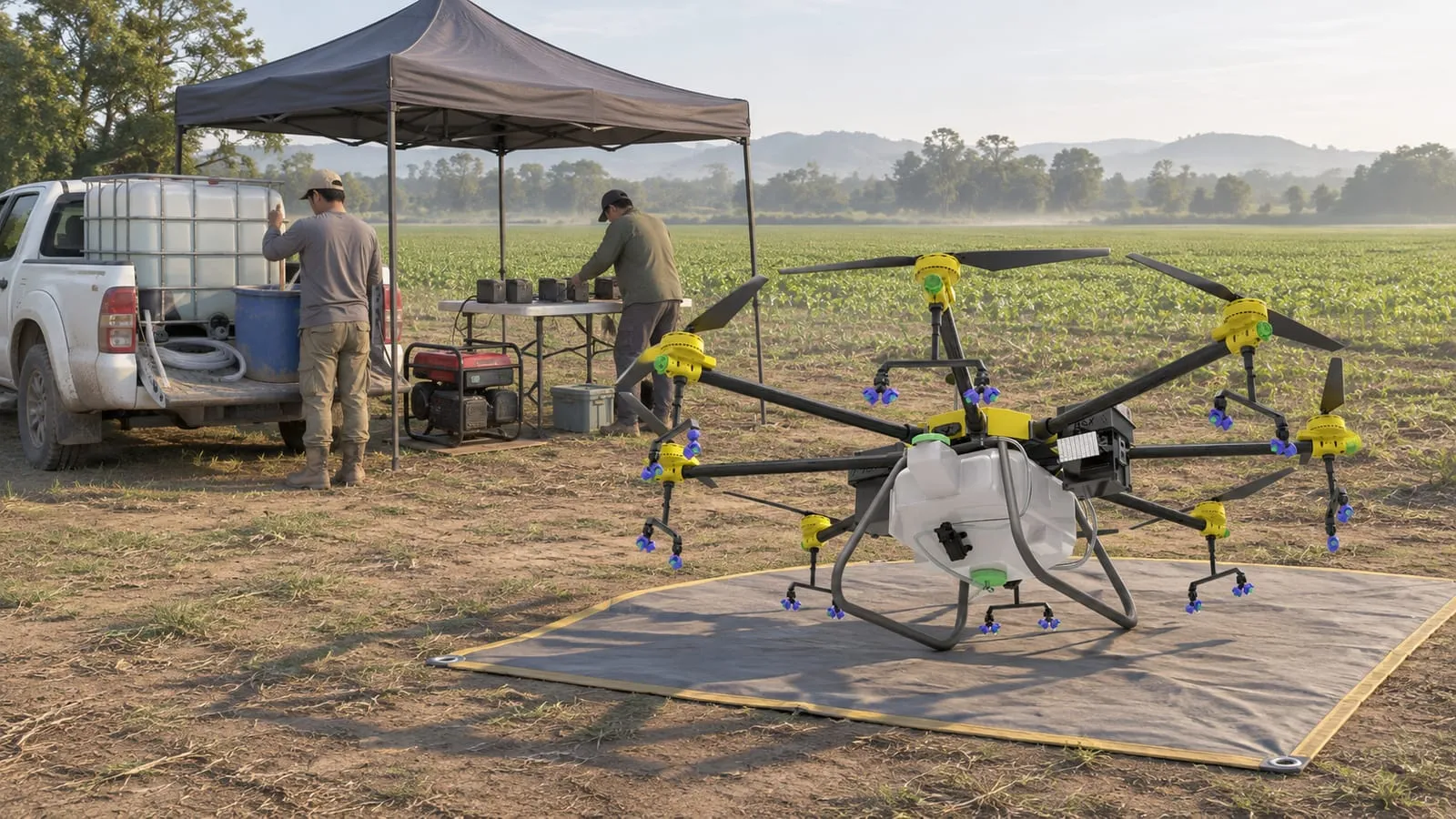
Short answer: A spray drone work site needs a clean landing strip, power for chargers, separate clean water and mixing water, a mixing place, shade for batteries and a safe view of the drone. You can start with a pickup truck, a generator and tanks. A trailer makes sense when you run several drones. A Purdue University extension guide says that specialised trailers can support mixing, loading, battery charging and elevated observing, and that grass lanes inside fields are good places to set up.
Three setup levels
| Level | Equipment | Good for | Limits |
|---|---|---|---|
| 1. Pickup kit | Pickup, small generator, 1–2 water tanks, table, shade cover, extinguisher | One drone, first season, small fields | Manual mixing, limited charging |
| 2. Trailer | Trailer with tanks, pump, generator, charging shelf, shade, storage | Two to three drones, regular customers | Needs a towing vehicle and access roads |
| 3. Truck or van | Closed body, mixing tank and pump, larger generator, battery racks, work light | Large service team, full-day work | High cost; road access needed |
The six needs at the field edge
- Landing and loading strip. Flat, clean, away from wires. Purdue notes that downwash can kick up dust and debris that block nozzles and disturb motors and electronics.
- Power. A generator or grid supply sized to the chargers. See the battery guide.
- Clean water. Separate from spray mix, for rinsing and hands. The Purdue guide advises bringing all the water you need for the day.
- Mixing. Premix where possible. Add half to two thirds of the water, then the product, then the rest. Do not mix concentrated products together first.
- Battery area. Shade, a non-flammable surface and space around the chargers.
- A view of the drone. A high point or vehicle roof helps over tall crops. Scout obstacles before you fly, and map wires and trees.
Example: generator and water for a 50 ha day
This is a planning example, not a promise of output.
- Spray volume: 50 ha × 20 L/ha = 1,000 L of mix. An F72 holds 72 L, so that is about 14 tank loads.
- Flights: at about 3.6 ha per full tank (72 L ÷ 20 L/ha), the drone needs about 14 flights.
- Power: two chargers of 2400 W each is about 4.8 kW. With a 25–30 % margin, a generator near 6 kW is a starting point. Check with the generator maker.
- Water: 1,000 L of mix plus clean water for rinsing and hands. Carry more than you think you need.
Battery rotation
A good pattern for one drone with three sets is: set A in the air, set B cooling, set C charging. At landing, A goes to cooling, B goes to charging and C goes to the drone. Label each set and write down the cycle count. For the formula to size your sets, see the battery guide.
Mixing safely
The Purdue guide advises operators to wear gloves at a minimum, to wash work clothes separately and to prefer premixed solutions in a large mixing tank over mixing in the drone tank. It also points out that drone carrier volumes are low (2 to 3 gallons per acre), so products are more concentrated and compatibility problems can appear. Test small batches and follow the label.
Safety checklist
- Scout the field and mark wires, poles and trees. Keep obstacle sensing on.
- Keep people and animals back from the landing area.
- Charge batteries in shade on a non-flammable surface, never unattended.
- Keep fuel for the generator away from chargers and batteries.
- Separate clean water from spray mix. Wash hands before you eat.
- Pack up by site: drain tank, rinse, wash, dry, fold, store batteries cool.
Match the setup to the drone
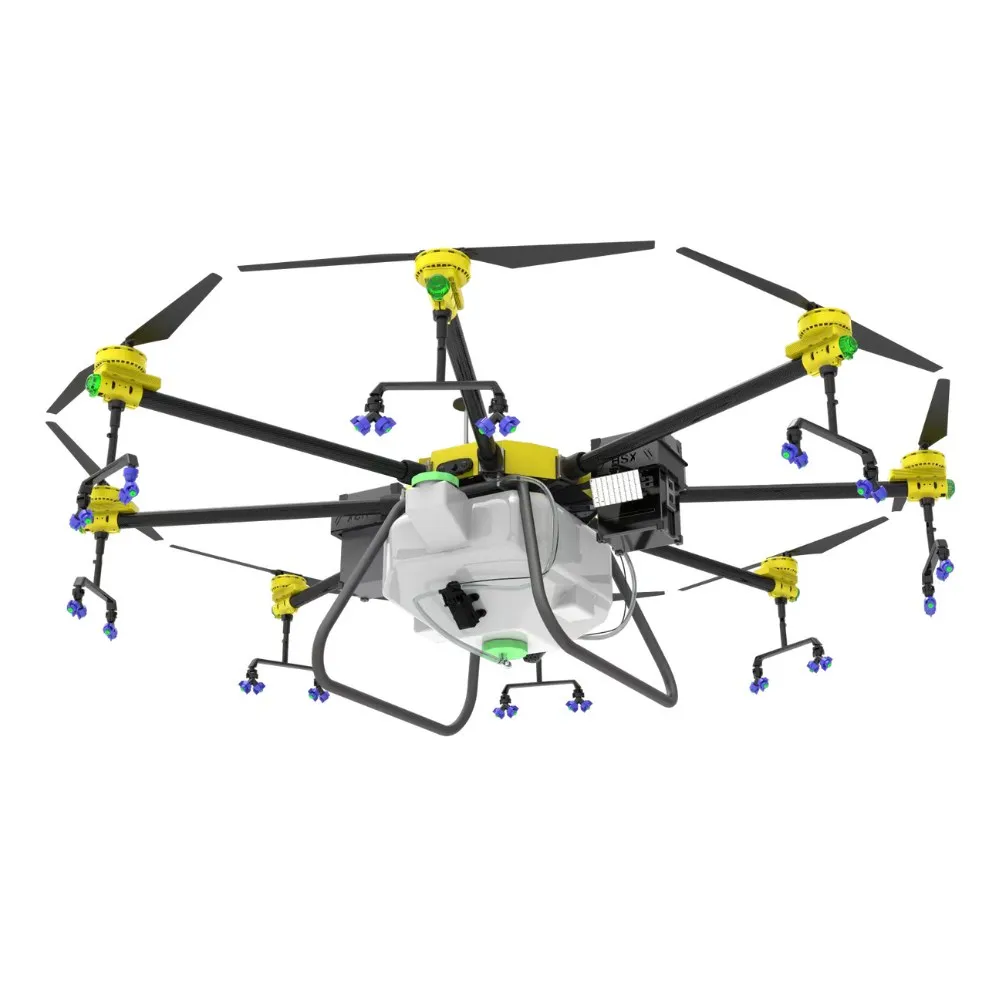
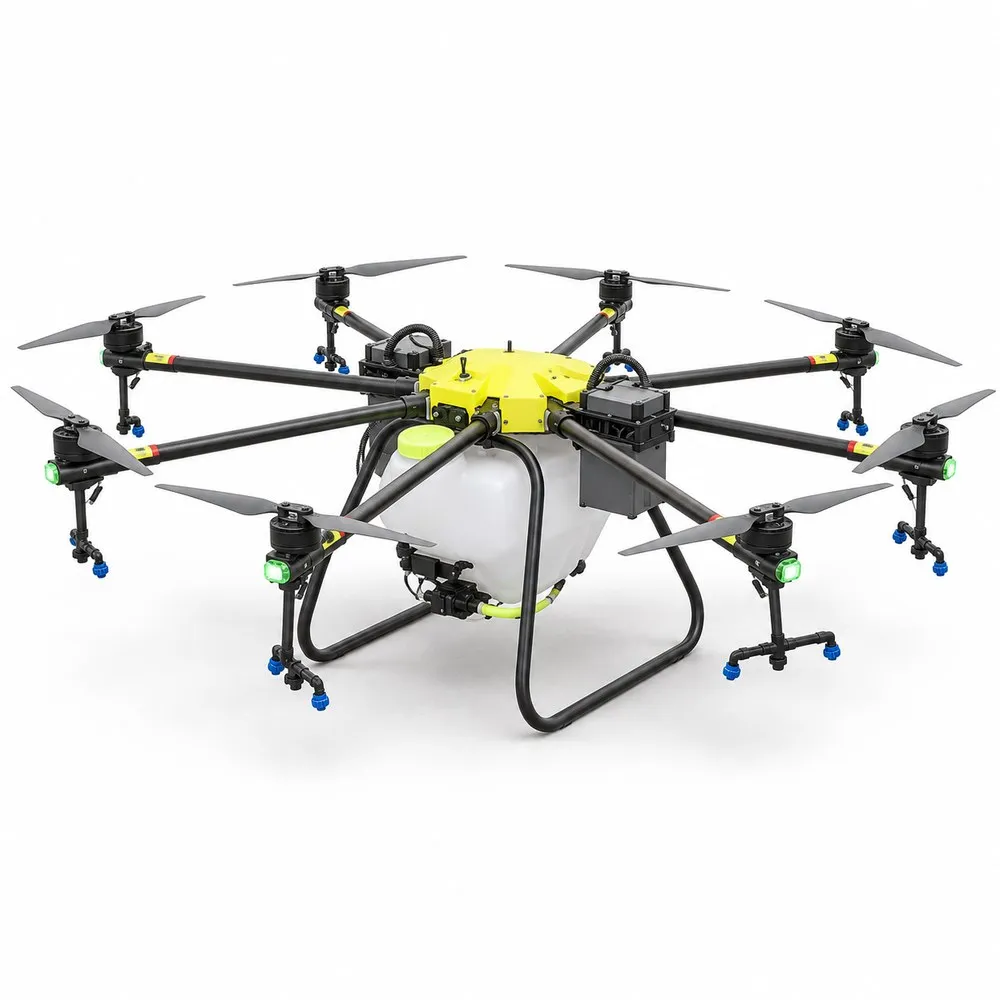
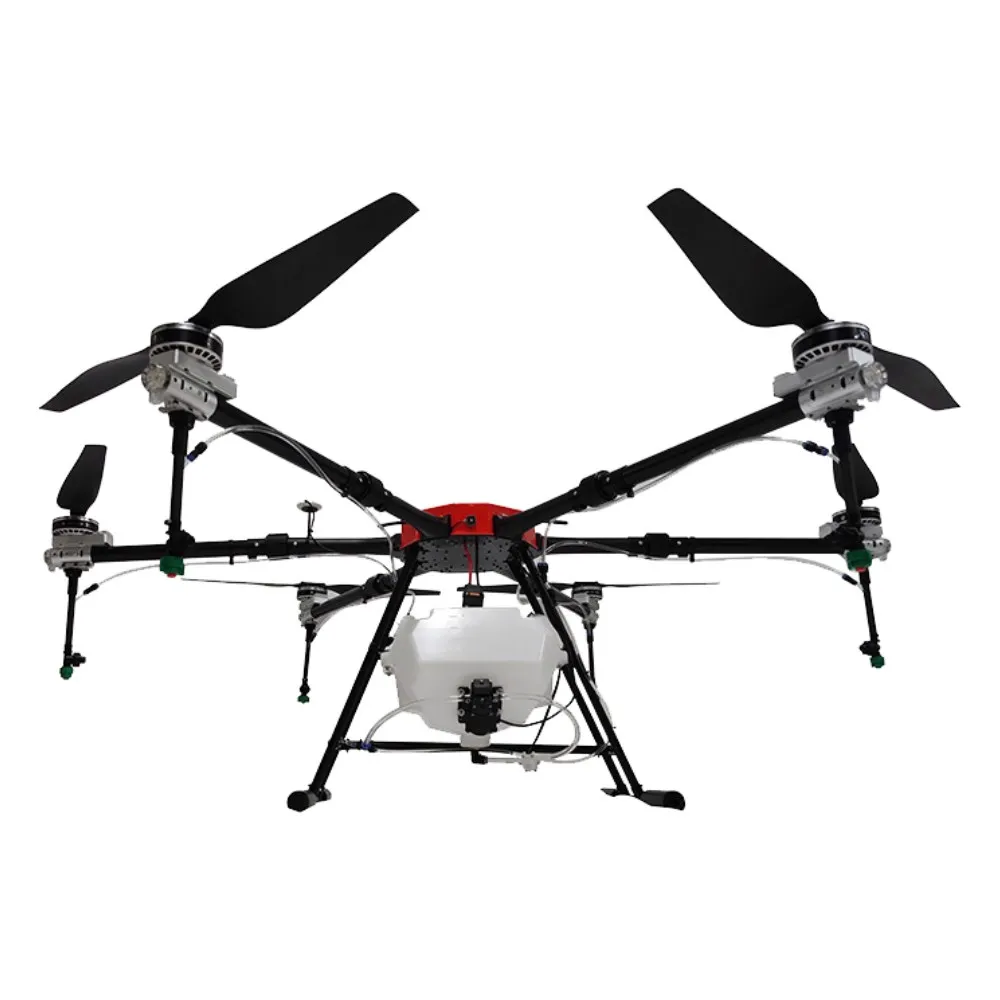
A compact F10-30 series drone fits in a car and needs little power. An F52 or F72 needs a pickup and a stronger generator. If you plan a service business, our spray service guide shows how teams plan crews and routes, and our support page explains training and parts. Ask for a quotation with the full kit through the contact page.
Related reading: battery guide, support and the F72 spray drone.