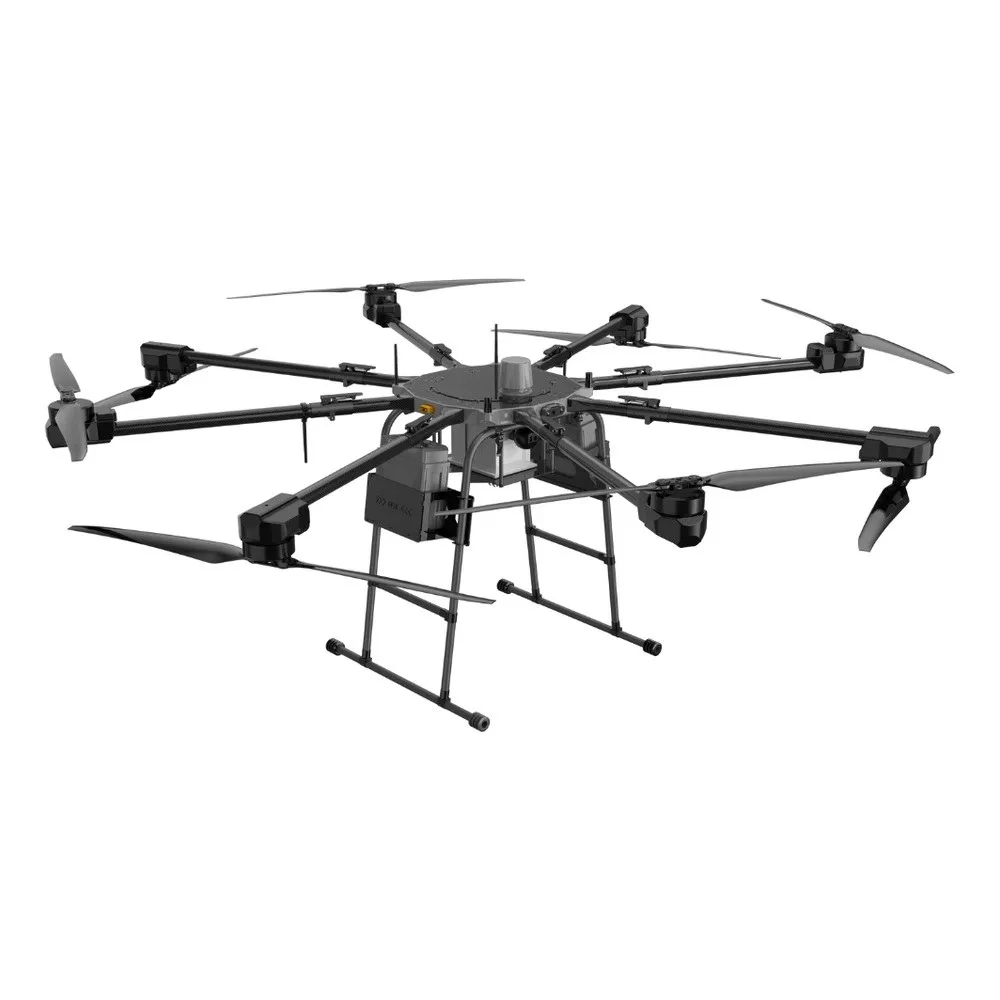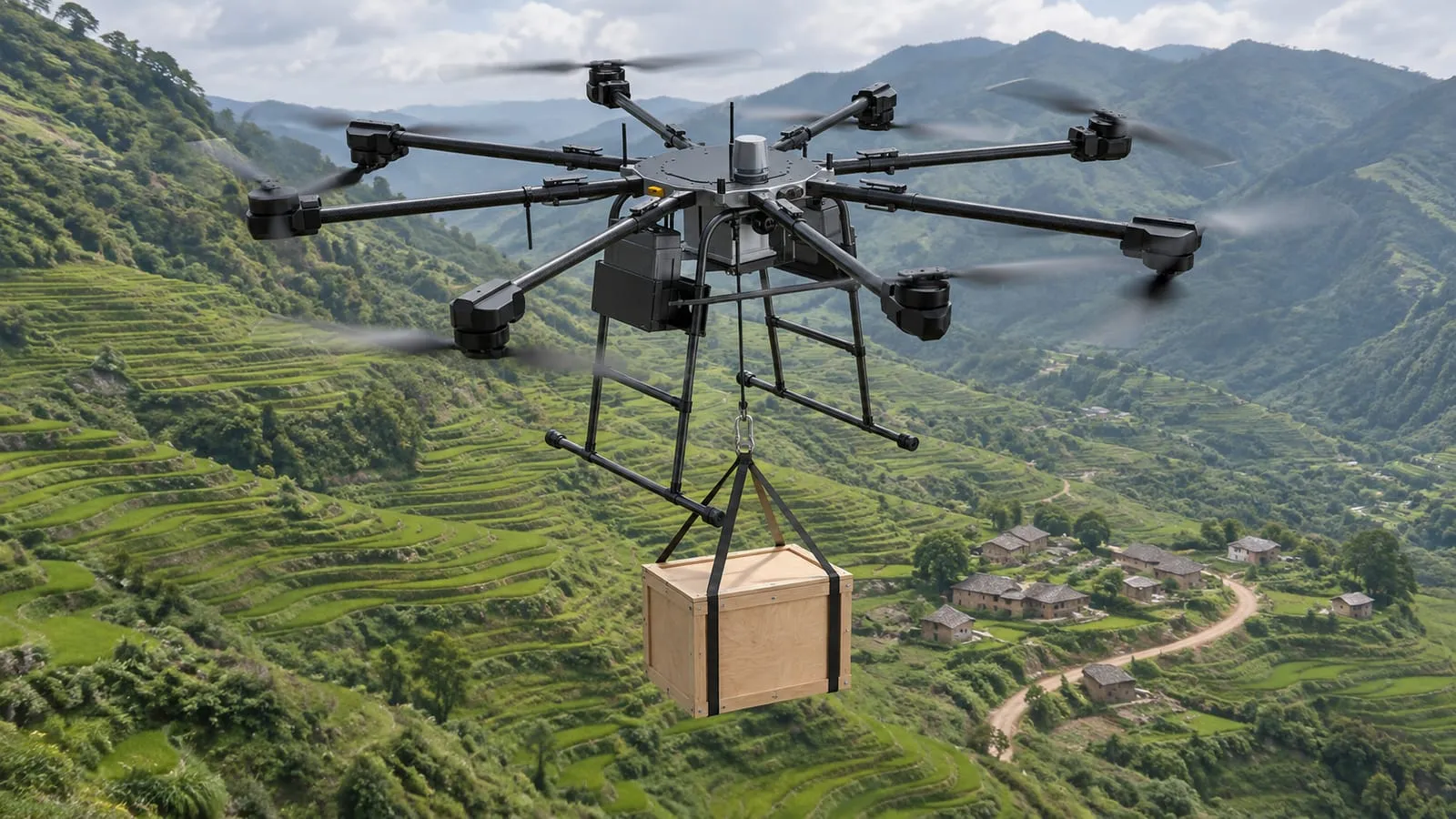
Short answer: A heavy-lift cargo drone is worth using when a route is short, repeated and hard to reach by road: a mountain farm, a hillside building site, a river crossing, or a cut-off village after a flood. It moves a limited load per trip. The FLYZOR FT100 is rated for 100 kg and 45 km range, but endurance drops from about 62 minutes lightly loaded to about 23 minutes at full load. Compare the cost per trip and per tonne-kilometre with porters, animals, trucks or helicopters before you buy.
Where cargo drones make sense
| Use | Typical cargo | Why a drone | Watch out for |
|---|---|---|---|
| Mountain farms | Seed, fertilizer bags, tools, crop harvest in small lots | No road, steep path, or a river between farm and road | Many small trips; weather and altitude |
| Construction sites on slopes | Cement, bricks, pipe, rebar, tools | Replaces carrying by hand where a crane cannot reach | Load limit per trip; safe drop area |
| Power-line and tower work | Poles, cable drums, tools, batteries | Saves long walks to remote towers | Rules for flights near lines |
| Rescue and relief | Food, water, medicines, shelter | Roads cut by flood or landslide | Needs trained crew, approvals and landing or drop point |
For relief work there is public evidence. The World Food Programme reported cargo drones reaching flood-hit communities in Nepal that were cut off by road and could not be reached by helicopter. WFP also reported a first drone delivery of nutrition supplies to remote communities in Madagascar in 2025. These cases are the agency’s own reports.
Payload against range
The FT100 specification, from its product page, shows how the trade works.
| Item | FT100 |
|---|---|
| Rated payload | 100 kg |
| Take-off weight | 270 kg |
| Flight range | 45 km |
| Speed | 20 m/s |
| Endurance | 23–62 min, depending on load |
| Cargo options | Transport box or drop release |
At full load the drone has only about 23 minutes in the air. A short route with a heavy load and a long route with a light load can both be correct, but not at the same time. Use your own cargo weight to find the real flight time.
Example: a hillside building site
This is an example to show the method, not a promise. A site sits 5 km from the road by air, and the job needs cement in 25 kg bags.
- Load per trip: 4 bags = 100 kg.
- Round trip: 10 km at 20 m/s is about 8.5 minutes in the air. Add 6 minutes for loading, drop and battery check. Each trip is then about 15 minutes. Full-load endurance of about 23 minutes leaves a small reserve, so a lighter load or a shorter route gives more safety margin.
- Trips per hour: about 4 if batteries are swapped fast. In a 6-hour working day, 20 trips could move 2,000 kg, but real output depends on battery sets and weather.
If a porter carries 25 kg per trip (an assumed example), the drone moves four porter-loads in one flight. Your own comparison will use local labor rates and the real path length.
How to compare costs
- Write down the route: distance, height difference, weight and number of trips per week.
- Price each option per trip: porters or animals (wages, time), truck or helicopter (hire rate), drone (battery cost per flight, crew, share of purchase price, insurance).
- Divide by the load to get cost per tonne-kilometre.
- Add the cost of approvals and training for the drone.
Do not use cost figures from a sales page without a method. A vendor claim that drones cut delivery time by a large share compared with ground transport is not a source until you can see the study.
Rules and safety
Drones above 25 kg need extra approval in most countries, and many places restrict flights beyond sight, over people and near airports. Lithium batteries ship as dangerous goods, so use a forwarder who handles them. Keep clear landing and drop zones, and plan an emergency return. Check with your aviation authority before the first flight.
Next step
Look at the FT100 transport drone for full specifications. If you plan to supply farms, builders or rescue teams in your area, see the dealer page or ask for a quote. Terms, price and support are by discussion.