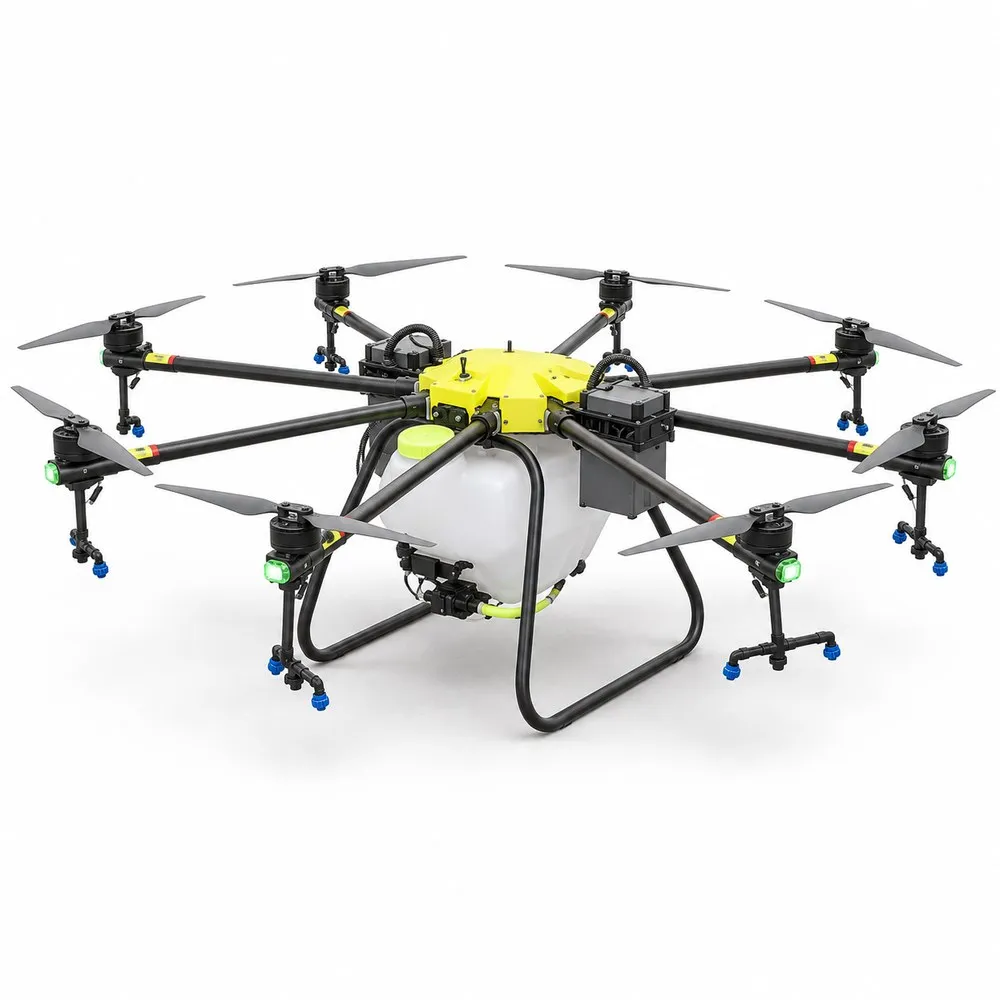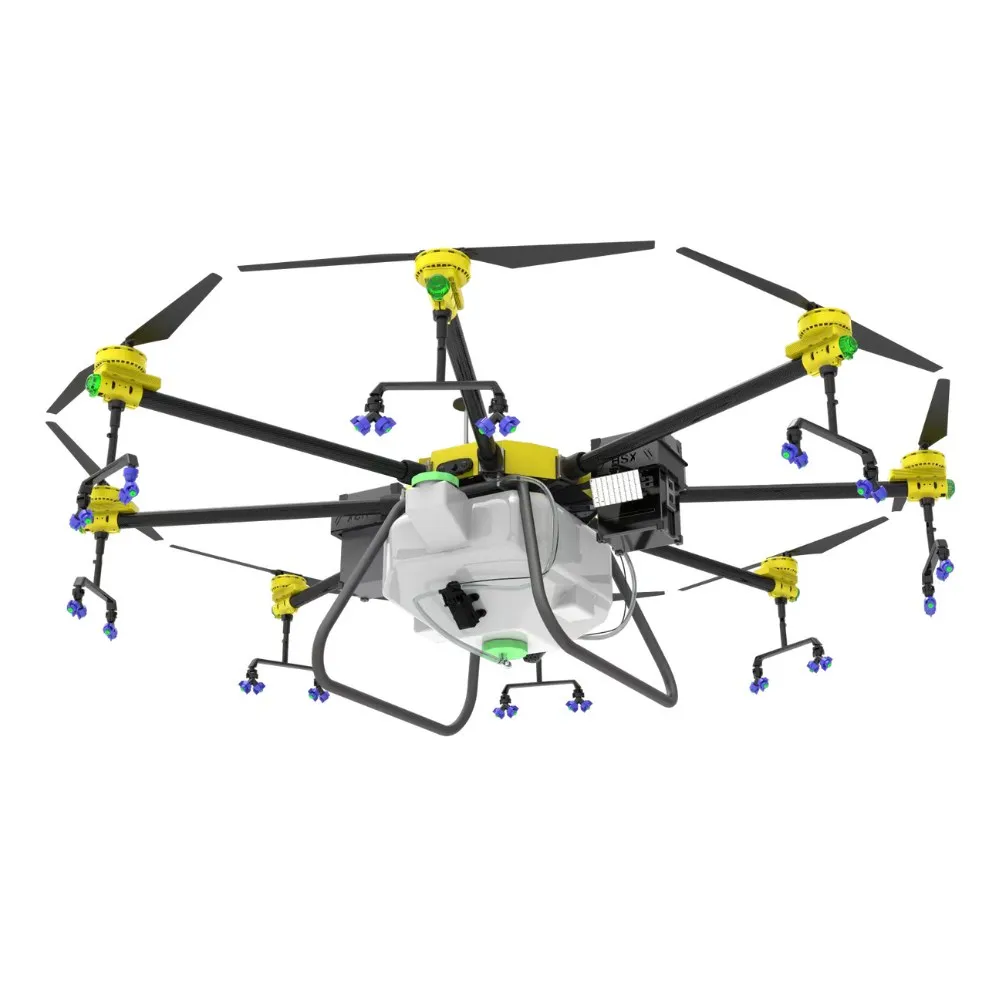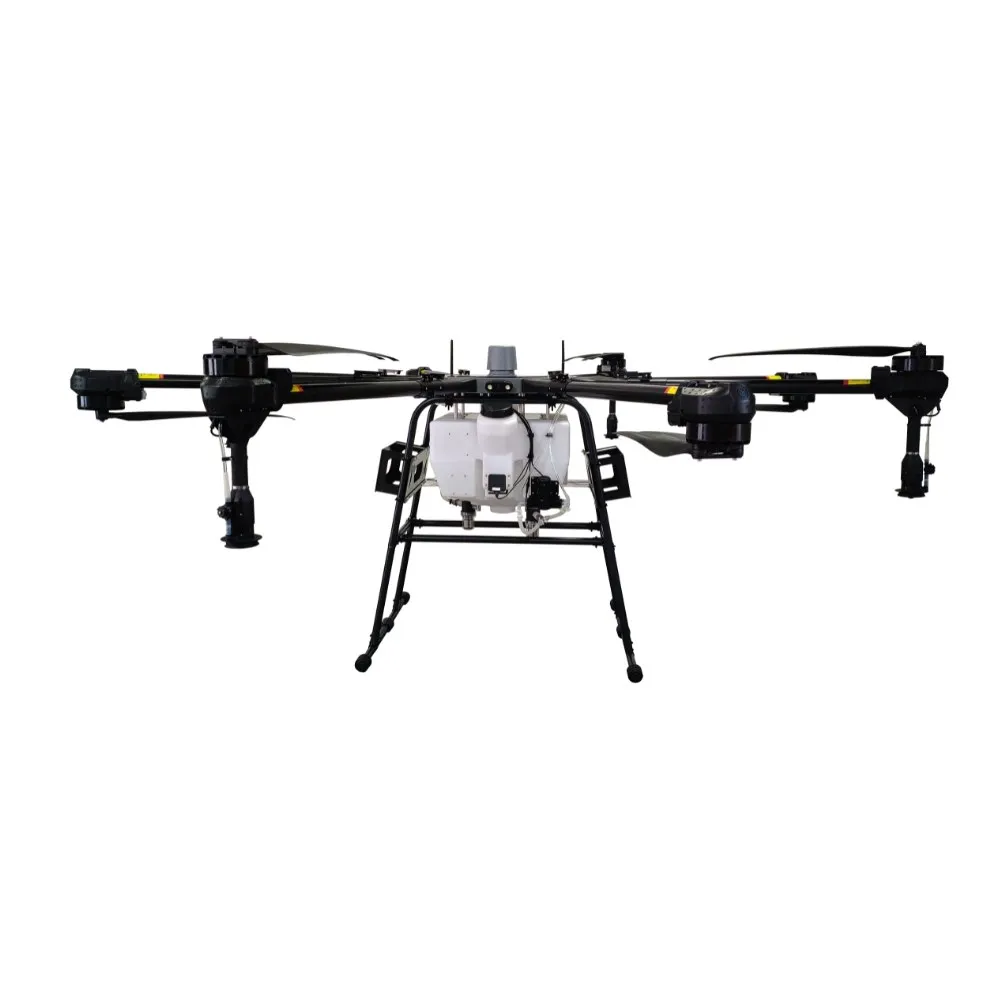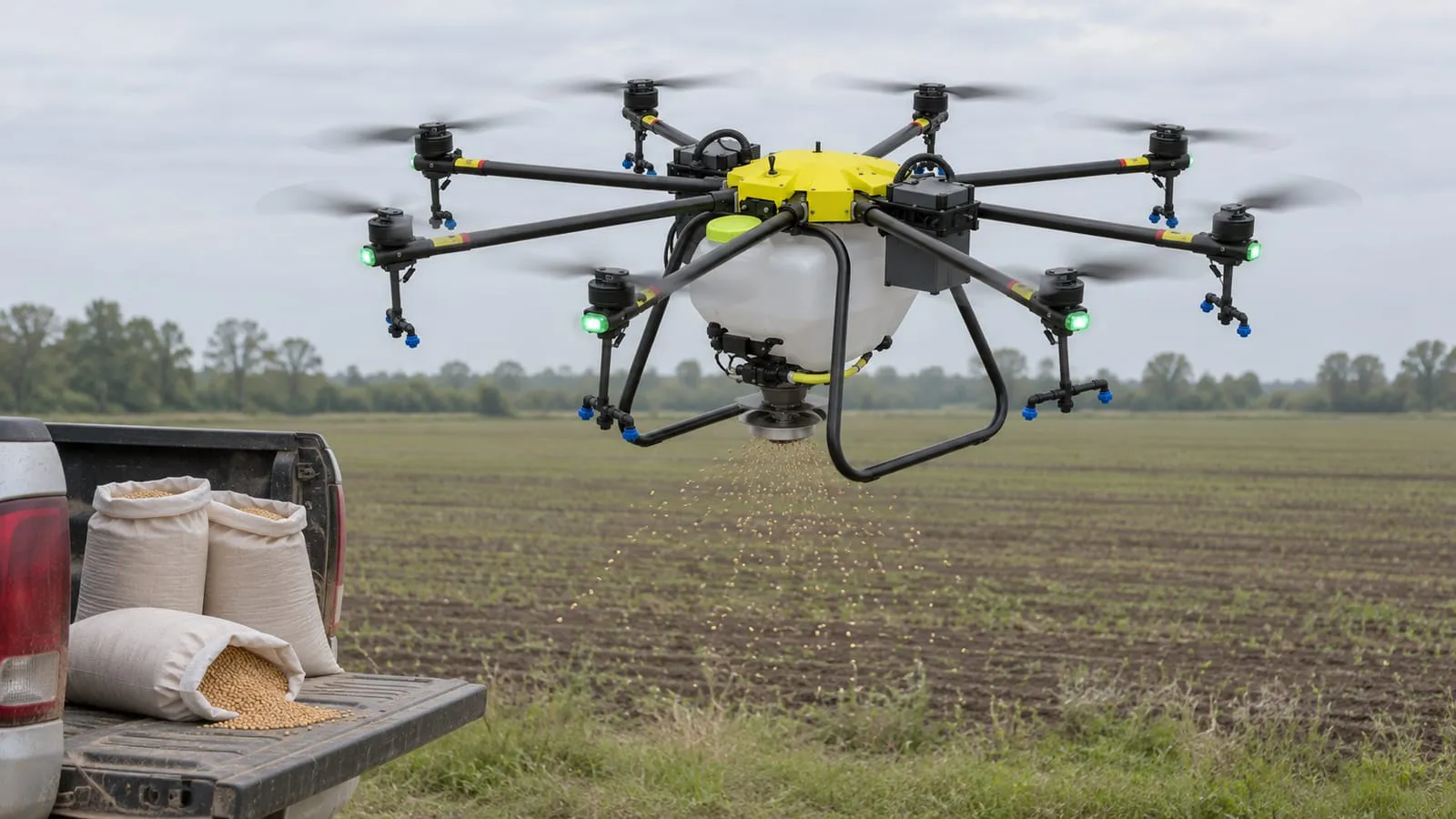
Short answer: A spreader drone can sow rice, cover crops and some pasture seed over fields that are wet, steep or already planted. It is a broadcast method, so it suits seed that does not need exact depth. Public seed rates are a guide, not a rule: Alabama Extension lists 20–60 pounds per acre for drone-applied cover crops, and an Indian trial found 40 kg per hectare of drone-sown rice performed like 30 kg per hectare with a drum seeder. Calibrate the flow for each seed lot and follow your local recommendation.
Where drone seeding fits
A drone drops seed from the air along planned flight lines. There is no soil contact, so the seed lies on the surface or in standing water. This is fine for several jobs, and a poor choice for others.
| Job | Why a drone helps | Watch out for |
|---|---|---|
| Direct-seeded rice | Works on wet or flooded fields where a tractor cannot enter; saves labor compared with hand broadcast | Uneven stands if the spread pattern is not tested; seed treatment and water control matter |
| Cover crops into a standing crop | Seed goes down before harvest, so it has time to grow in autumn | Needs rain and light; thick leaf cover can reduce emergence |
| Pasture and hillside seeding | Reaches slopes and wet ground; no ground traffic | Little published data; seed size and coating change flight behavior |
| Row crops needing exact depth | Not a good fit | Use a drill or planter |
What public sources say about rates
Rates below come from the sources listed at the bottom of this page. They describe specific places, varieties and seasons. Treat them as examples that tell you the order of size.
- Cover crops: Alabama Extension gives nominal drone rates of 20 to 60 pounds per acre (about 22–67 kg per hectare), depending on the species or mix. Extension work also notes that seed broadcast on the surface is often raised above drilled rates to make up for lower emergence.
- Rice: An Indian trial compared drone seeding at 40 kg per hectare with a drum seeder at 30 kg per hectare and found comparable growth and yield. A PhilRice specialist cited 40 kg per hectare for mechanized seeding. Other reports give higher rates for direct-seeded rice, so check the current advice from your rice institute.
- Pasture: We did not find a reliable extension rate for drone-sown pasture. Use the rate you already use for broadcasting, and test a small plot first.
Calibrate before you sell the service
Seed is not like fertilizer. It has different size, weight and shape, and it flows differently from the box. A thesis from Auburn University reported that one drone’s own calibration under-applied cereal rye by about 9.5–17.7 %. Do your own test:
- Fill the box with the exact seed lot you will use.
- Run the feeder for a set time (for example 60 seconds) over a sheet or tray and weigh the seed.
- Convert the result to kilograms per minute and compare it with the flight speed and swath to find kilograms per hectare.
- Lay trays across the swath, fly one pass, and weigh each tray. If the middle is heavier than the edges, change the spread width or overlap.
- Write down the setting for that seed lot. Repeat with every new batch.
Example: loads for a rice job
This is an example to show the method, not a promise. Rice seed at 40 kg per hectare, a 20-hectare job and a 60 kg spreading box (the size on the F52):
- Seed needed: 20 ha × 40 kg = 800 kg.
- Loads: 800 kg ÷ 60 kg = about 13.3, so 14 loads.
- Area per load: 60 kg ÷ 40 kg per ha = 1.5 ha.
Seed is light for its volume, so a box may hold less than its rated kilograms. Weigh a full box of your seed before planning. The F72 has an 80 kg box and needs fewer refills. Our granular spreading page covers fertilizer and feed on the same equipment.
Limits to tell your customers
Wind moves seed, and a strong gust can leave a gap or double a strip. Fly in light wind and keep the same height each time. Plan overlap by test, not by guess. Pre-soaked rice seed is sticky and can block a feeder, so ask your supplier what the box can handle. Finally, rules on aerial seeding vary by country, and some places control the seed varieties you may sow. Ask your agriculture ministry.
Is it a good business?
Seeding adds a second season to a spray drone. A team that sprays in summer can spread in spring and autumn with the same aircraft, which shortens payback. Read the spray service business page to see how this works with spraying. If you plan to sell seeding kits in your area, see the dealer program or ask for a quote. Terms and prices are by discussion.